Dave Smith and Elizabeth Savage Present Annual Appellate Update at OTLA Convention
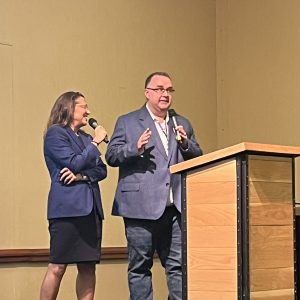
Spooner Staggs partner Dave Smith and appellate lawyer Elizabeth Savage presented an update on significant Oregon appellate decisions at the Oregon Trial Lawyers Association’s Annual Convention.
During the fast-paced CLE program, Smith and Savage examined notable 2025–26 decisions affecting insurance coverage, personal injury litigation, wrongful death damages, governmental liability, medical negligence, employment law, attorney fees, and the use of artificial intelligence in legal practice.
Savage brought deep appellate experience and a sharp command of the year’s most consequential decisions. She practices appellate law, civil litigation, and family law; serves as a pro tem judge and court-appointed arbitrator; and co-chairs OTLA’s Amicus Committee. Savage is also running to be one of the next Multnomah County Circuit Court judges. Smith and Savage divided the cases between them, giving attendees a practical overview of both the courts’ reasoning and the decisions’ likely effects on Oregon litigants.
Important Developments in UM/UIM “Stacking”
Smith focused in part on two significant decisions involving the “stacking” of uninsured and underinsured motorist coverage.
Stacking refers to a policyholder’s ability to access coverage under more than one insurance policy. The issue often arises when the coverage available under the policy applying directly to a collision is insufficient to compensate an injured person fully. Smith will examine Oregon stacking law in greater depth during an upcoming OTLA Motor Vehicle Section CLE.
Sheppard v. Progressive Classic Insurance Company
In Sheppard, the plaintiff was injured while occupying a work vehicle and sought to combine the underinsured motorist coverage provided through her employer with the coverage available under her personal automobile policy.
The case required the Oregon Supreme Court to interpret the statutory exclusion that applies when an insured occupies a vehicle “furnished for the regular use” of the insured.
Earlier Oregon authority had treated a vehicle furnished for business use as one furnished for regular use, substantially limiting a worker’s ability to access additional UIM coverage under a personal policy after being injured in an employer-provided vehicle.
Sheppard replaced that broad approach with a more fact-intensive inquiry. A vehicle is furnished for regular use when the insured has the right or privilege to use it on a steady or uniform basis and the opportunity to use it arises with some frequency.
That distinction matters. Whether a particular work vehicle qualifies will depend on the actual circumstances surrounding the employee’s access to and use of the vehicle. As Smith explained, the decision may make it more difficult for insurers to resolve these disputes through summary judgment and may allow additional policyholders to pursue coverage under their personal policies.
Smith wrote an amicus brief in Sheppard on behalf of OTLA.
Rogers v. Farmers Insurance Company of Oregon
Rogers addressed a different stacking question involving two vehicles owned by the same policyholder but insured under separate Farmers policies.
The plaintiff was injured while driving her Mazda. Farmers paid the UIM limit under the Mazda policy but denied coverage under her separate policy covering a Lexus.
The Oregon Court of Appeals rejected Farmers’ position. It held that an owned vehicle insured under a separate policy could qualify as “an insured vehicle” under ORS 742.504(4)(b) and therefore fall within an exception to the policy’s owned-vehicle exclusion.
The decision could significantly affect policyholders who insure multiple vehicles under separate policies and seek to access more than one source of UM/UIM coverage. Farmers petitioned the Oregon Supreme Court to review the decision, with insurance-industry interests filing amicus briefs supporting review.
Wrongful Death and Oregon’s Damages Cap
Savage covered two decisions examining Oregon’s $500,000 statutory cap on noneconomic damages in wrongful death cases.
In Estate of Ritchie v. Helbig, the Court of Appeals upheld application of the cap. The court concluded that the cap did not violate Oregon’s constitutional right to a jury trial and that, in the Court of Appeals’ opinion, the plaintiff retained a constitutionally adequate remedy in light of the total recovery obtained.
In Estate of Fisher v. Lee, however, the court reached a different result when applying the cap. The decedent was 23 years old, remained conscious while suffering catastrophic injuries, and left a wife and infant daughter. The plaintiff obtained an award of $20 million in noneconomic damages, which the trial court reduced to $500,000.
The Court of Appeals held that applying the cap under those circumstances would leave the plaintiff with a remedy so disproportionately small that it violated the remedy clause of the Oregon Constitution.
While Oregon’s wrongful death cap may have survived a facial constitutional challenge in Ritchie, Fisher demonstrates that an as-applied challenge remains viable. Time will tell how this ultimately plays out when an appropriate case reaches the Supreme Court.
Governmental Immunity and Injured Workers
Savage also discussed Crandall v. State, in which the Oregon Supreme Court examined the constitutionality of immunity granted to public bodies when a worker’s injury is covered by workers’ compensation law.
A firefighter operating a bulldozer at the Sugar Pine Fire warned a state supervisor that darkness, smoke, and dust made the road unsafe. He was instructed to proceed, and the bulldozer left the road and rolled several times, causing severe injuries.
The Supreme Court concluded that the workers’ compensation benefits available to the plaintiff did not provide a sufficiently substantial substitute for the tort remedy eliminated by governmental immunity. Unlike ordinary workers’ compensation cases, in which an injured employee may still pursue a negligent third party, the immunity statute shifted the cost of the state employee’s alleged negligence to the injured worker, the worker’s employer, and the workers’ compensation insurer.
Turning Appellate Decisions into Practical Guidance
Smith and Savage did more than identify notable cases. They translated a wide range of appellate decisions into practical guidance Oregon trial lawyers can use when evaluating coverage, preserving claims, developing evidence, requesting attorney fees, and preparing matters for trial or appeal.
Spooner Staggs congratulates Dave and Elizabeth on an informative and timely presentation – and thanks OTLA for continuing to give Oregon trial lawyers a forum to share knowledge, strengthen advocacy, and improve the law for the people they represent.